

The 6 Best Portable Power Stations for Van Life, Camping, and Off‑Grid Battery Backup
There’s a special confidence that comes from hearing your mini‑fridge hum and your laptop charge while you’re miles from the nearest outlet. The right portable power station turns a van, tent, or cabin into a reliable micro‑grid—silent, fume‑free, and powered by sunshine. Whether you need a compact solar generator for weekend camping or a robust battery backup for off‑grid living, the picks below are standout performers for capacity, recharging speed, and pure sine wave power that treats sensitive electronics right.
Why portable power matters for van life, camping, and off‑grid living
The difference between “roughing it” and living comfortably outdoors often comes down to power. A portable power station keeps essentials running: phones, cameras, lights, routers, fans, CPAPs, mini‑fridges, even some cooking gear. You’re not guessing how long a power bank will last; you’ve got a high‑capacity battery with outlets that behave like home.
Unlike gas generators, solar‑ready battery stations are quiet and emission‑free. They can charge from your van’s alternator, AC at home, or foldable panels at camp. That flexibility gives you a true backup plan for outages and a seamless off‑grid routine.
How to size your system (and not be disappointed)
Two numbers matter most: watt‑hours (Wh) and watts (W). Watt‑hours are your “tank size”—how much energy the battery stores. Watts are the inverter’s output—what it can deliver at once. Add up your daily loads: a 60W laptop for 3 hours (180Wh), a 50W fridge cycling 24/7 (roughly 300–600Wh/day), lights and phones (100–200Wh). A weekend camper might be fine with 300–600Wh; van lifers often want 1–2kWh or more.
For appliances and sensitive gear, choose a pure sine wave inverter. It mimics household power so laptops, camera chargers, Starlink routers, and CPAP machines run cleanly. Also consider idle consumption and inverter overhead—big inverters waste more power at low loads. If you mostly run DC gear (12V fridges, routers), using the DC outputs improves efficiency and extends runtime.
Solar charging reality check and pass‑through considerations
Panel wattage is not the same as real‑world production. A 200W panel might average 120–160W in good sun; bifacial designs can capture a bit more. MPPT solar controllers harvest energy more efficiently than PWM, so look for MPPT built‑in. Estimate charge time by dividing usable battery Wh by realistic solar input. For example, 1,000Wh with 250W effective solar could take 4–5 hours of good sun.
Many stations support charging while powering devices (often called pass‑through). That’s convenient for continuous loads like fridges, but it generates heat. For battery health, follow the maker’s guidance and avoid pushing high charge and discharge rates simultaneously in extreme temps. If you plan to live on solar, prioritize higher solar input limits, faster AC charging (for quick top‑ups on shore power), and LiFePO4 chemistry for long cycle life.
Selection criteria used for this roundup
- Real capacity and inverter match: Practical Wh for your use, plus pure sine wave AC output sized to your heaviest loads.
- Solar performance: MPPT support and meaningful solar input; included or supported solar options that keep up in real life.
- Fast, flexible recharging: AC, car, and solar options; the ability to rapidly top up when windows of power are short.
- Battery chemistry and lifespan: Preference for LiFePO4 (LFP) with high cycle counts and robust BMS protections.
- Portability and van integration: Weight, handles, footprint, and ventilation for easy stowage under benches or in cabinets.
- Ports that matter: 100W USB‑C PD for laptops, multiple AC outlets, regulated 12V outputs.
- Expandability and ecosystem: Extra batteries or panels to scale with your needs.
- Brand reliability and safety: Track record, protections (over/under‑voltage, short‑circuit, over‑temp), and clear documentation.
1. DaranEner 576Wh LiFePO4: Compact, quiet power with 600W pure sine AC and 100W USB‑C

576Wh LiFePO4 power station: 600W pure‑sine output, 100W USB‑C PD, fast solar charging, quiet long‑life backup for trips, work, and outages.
$259.99 on Amazon
View on AmazonPrice and availability are accurate as of 01/31/2026 07:42 pm GMT and are subject to change.
If you need dependable power in a small footprint, the DaranEner Cubus600L hits a sweet spot. With 576Wh on tap and a 600W pure sine wave inverter (1,200W surge), it’s right‑sized for laptops, camera batteries, CPAPs, mini‑fridges, and LED lighting. The 100W USB‑C PD port is clutch—no bulky adapters required for fast laptop charging. Three AC outlets and a regulated 12V car socket keep your van or tent organized and powered.
Recharging is flexible: AC or car power, plus a built‑in MPPT controller that pairs well with a 100–120W panel for a practical 5–5.5‑hour solar refill in good conditions. The LiFePO4 chemistry and robust BMS yield long cycle life and low noise—great for sleeping in a van while it runs a fridge or router. It’s not designed for high‑draw cooking gear, but as a mid‑size, quiet workhorse, it’s ideal for weekend adventures and as a home outage buffer.
2. EcoFlow DELTA 2 Solar Generator: 1kWh LFP, 1,800W AC, fast solar—and expandable to 3kWh

Go off-grid with quiet, fume-free power: 1800W output, expandable 1-3kWh, fast solar charging with a 220W bifacial panel and 3,000+ cycle life.
$639.00 on Amazon
View on AmazonPrice and availability are accurate as of 01/31/2026 07:43 pm GMT and are subject to change.
DELTA 2 is the “do‑most‑things” portable power station. The 1,024Wh LiFePO4 battery, 1,800W pure sine inverter, and 15 total outputs make it comfortable running a fridge, induction hot plate, power tools, or an e‑bike charger. It welcomes solar: up to 500W input, and it ships with a 220W bifacial panel that captures extra reflected light to speed charging on bright days.
For van lifers and off‑grid cabins, the expandability to 2–3kWh is a major advantage—scale up as your needs grow. AC fast charging gets you quickly topped off before hitting the trail, while high solar acceptance helps truly live on sunshine. It’s bulkier than a day‑trip unit, but the performance, longevity (3,000+ cycles), and upgrade path are standouts for serious camping and reliable home backup.
3. Jackery Explorer 1000 v2: 1,070Wh LFP with 1,500W pure sine AC and ultra‑fast 1‑hour charging

Powerful, lightweight backup: 1,070Wh with 1,500W output, 1-hour fast charge via app, durable 10-year LFP battery—great for trips, emergencies, or off-grid life.
$424.65 on Amazon
View on AmazonPrice and availability are accurate as of 01/31/2026 07:43 pm GMT and are subject to change.
For campers and road‑trippers who prize quick turnarounds, the Explorer 1000 v2 is compelling. Its 1,070Wh LiFePO4 pack feeds a 1,500W pure sine inverter, enough for most van or cabin essentials—from mini‑fridges and laptops to cooking appliances in moderation. The 100W USB‑C port covers modern laptops, and three AC outlets simplify multi‑device setups.
What sets it apart is speed. With the app’s emergency charging mode, you can refill from empty to full in about an hour—perfect for a last‑minute power top‑off before leaving the house or while grabbing lunch on shore power. The trade‑offs: it’s a closed solar ecosystem, so plan on Jackery panels; and it doesn’t accept expansion batteries. If you want a highly portable, mid‑capacity station that charges faster than most, this is a polished, dependable pick.
4. BLUETTI AC50B: Ultra‑portable 448Wh LFP with 700W AC and rapid “Turbo” top‑ups
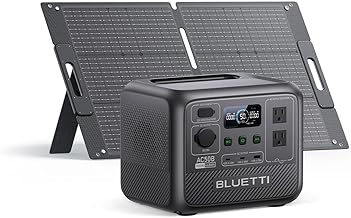
Lightweight 14.8 lb power station with 448Wh and 700W output — long‑life LiFePO4 battery, rapid charging, and multiple ports for all your camp devices.
$598.00 on Amazon
View on AmazonPrice and availability are accurate as of 01/31/2026 07:43 pm GMT and are subject to change.
If you travel light but want real AC power, the AC50B is a packable powerhouse. At under 15 pounds, it slips easily under a van bench or into a rooftop cargo box, yet delivers a 700W pure sine inverter—plenty for laptops, camera chargers, drones, projectors, and many compact kitchen gadgets. With two 65W USB‑C ports and a regulated 12V outlet, it covers most modern kits without adapters.
Charging is brisk: enable Turbo in the BLUETTI app for up to 580W AC input and a near 45‑minute jump to 80%. Pair it with a ~200W panel for a practical full solar charge around 3 hours of strong sun. Capacity is modest, so plan your loads or carry a companion panel. As a featherweight, long‑life LiFePO4 station designed for fast turnarounds, it’s a superb weekender and a smart backup for smaller rigs.
5. Anker SOLIX C2000 Gen 2 + PS200: 2,048Wh LFP, 2,400W pure sine AC, 58‑minute full recharge, expandable to 4kWh

Ready for road trips, RVs & outages: C2000 Gen2 + PS200 gives 2,400W (4,000W peak), 58‑min full recharge, expandable to 4kWh and IP67 solar. Tap to learn more.
$1,099.99 on Amazon
View on AmazonPrice and availability are accurate as of 01/31/2026 07:44 pm GMT and are subject to change.
For van builds and cabins that graduate from “portable” to “primary power,” the C2000 Gen 2 is a top‑tier choice. The 2,048Wh LiFePO4 battery and 2,400W pure sine inverter confidently handle demanding loads—RV or window A/Cs, induction cooktops, air fryers, and multi‑appliance usage at once. Add an expansion battery to reach ~4kWh when you need days of autonomy.
Recharging speed is class‑leading: up to 80% in 45 minutes and 100% in 58 minutes using AC and solar together—perfect for brief shore‑power windows or cloudy‑day resets. The included 200W panel is IP67‑rated for weather resistance and set‑angle adjustable to maximize harvest. For smaller vans, consider the footprint and weight; for larger rigs or off‑grid homes, it’s a flexible, future‑proof hub that can anchor your whole system.
6. Grecell 330W (230Wh) Kit: Ultra‑light solar generator with 40W foldable panel and 60W USB‑C PD

Compact 230Wh solar power kit with foldable 40W panel — fast 60W USB‑C, 6 ports, lightweight and ideal for camping, road trips, or blackout backup.
$199.99 on Amazon
View on AmazonPrice and availability are accurate as of 01/31/2026 07:44 pm GMT and are subject to change.
This is the grab‑and‑go kit for minimalists, solo travelers, and day‑use camps. With 230Wh of capacity and a 330W pure sine inverter (600W surge), it quietly powers essentials: phones, cameras, lights, routers, small fans, and occasionally a compact appliance within its limits. The included 40W foldable panel keeps it topped up on sunny days, and the 60W USB‑C PD port is a welcome touch for quick laptop refuels.
It’s not built for fridges or cooking gear over long weekends—small capacity and a modest solar panel mean careful load management. But as a lightweight, all‑in‑one entry into solar generators, it’s hard to beat for hikers, festival goers, or as a simple blackout buffer at home. Tuck it under a van seat and you’ve always got clean power on hand.
FAQ
- How many watt‑hours do I need for van life?
- For light use (phones, lights, laptop), 300–600Wh works for weekends. Add a 12V fridge, router, and occasional cooking, and 1,000–2,000Wh is more comfortable. If you’re full‑time or running A/C, consider 2kWh+ with expansion options.
- Can I run sensitive electronics like laptops and CPAPs?
- Yes—choose a pure sine wave inverter. All models in this guide provide pure sine AC, which mirrors household power and protects sensitive chargers and medical devices.
- How fast will solar recharge my battery?
- Divide usable Wh by real solar input. A 1,000Wh station paired with a 200W panel might average 120–160W in good sun, for roughly 6–8 hours to full. Bifacial or multiple panels, MPPT controllers, and optimal tilt reduce charge time.
- Is pass‑through charging safe?
- Many power stations can power devices while charging, but it generates heat and can stress cells at high rates. For longevity, avoid maxing out charge and discharge at once, keep the unit ventilated, and follow manufacturer recommendations.
- What should I consider for van installation?
- Leave ventilation space, secure the unit against movement, and use short, appropriately fused cables for 12V charging. Check size and weight for storage bays, and avoid placing units in sealed, high‑heat compartments.
Power Without the Plug: Match the Right Station to Your Adventure
- Best compact LiFePO4 all‑rounder for vans and weekenders: DaranEner 576Wh. Quiet, safe pure sine power with fast 100W USB‑C and practical solar recharging—easy to tuck under a bench and ideal for fridges, CPAPs, and work gear under 600W.
- Best expandable mid‑size solar generator: EcoFlow DELTA 2. A true off‑grid workhorse with 1,800W AC, high solar input, and an included 220W bifacial panel—grow to 3kWh as your needs evolve.
- Fastest turnarounds in a portable 1kWh class: Jackery Explorer 1000 v2. One‑hour AC refills via app, steady 1,500W pure sine output, and a durable LFP battery for years of trips and storm seasons.
- Best lightweight weekender with rapid top‑ups: BLUETTI AC50B. Under 15 pounds with 700W AC and Turbo charging—perfect for minimalist kits that still want real AC and speedy recharges.
- Best “primary power” hub for RVs and off‑grid cabins: Anker SOLIX C2000 Gen 2 + PS200. 2.4kW pure sine, 2kWh LFP, 58‑minute full recharge, and expansion to 4kWh—run the big stuff confidently.
- Best ultra‑portable starter kit: Grecell 330W (230Wh) with 40W panel. A budget‑friendly, lightweight solar generator that covers the basics and fits anywhere.
The right portable power station lets you roam farther, stay longer, and work or relax without compromise. Pick the capacity that matches your daily use, give yourself enough solar to refill in the sun you actually get, and choose pure sine wave AC so every device you own runs cleanly. Then hit the road—your own personal grid is coming with you.








Leave a Comment