

The Best Smart Plugs and Power Strips With Power Monitoring (and the Best Alternatives)
If you’ve ever looked at your electric bill and thought, “There’s no way I used that much,” you’re not alone. Small, always-on electronics—those sneaky “vampire power” culprits—sip energy 24/7. Smart plugs with energy monitoring make those invisible watts visible, so you can spot waste, automate schedules, and lower your monthly costs without guessing.
Below, I break down the best smart plug energy monitoring options, Wi‑Fi outlets with power usage visibility, and the smartest power strips for multi-device control. I focus on data accuracy, app usability, and rock-solid Alexa/Google integration, so your automations actually help—not hassle.
Why Smart Plugs (With and Without Energy Monitoring) Matter
Smart plugs are the quickest path from “dumb outlet” to automated control. The big win: visibility. Real-time monitoring shows exactly what a lamp, dehumidifier, or office gear is drawing right now, not just a monthly lump sum. That clarity helps you identify vampire loads—set-top boxes, chargers, printers—so you can set timers or cut power when you’re away.
Even if a plug doesn’t track kWh, scheduling and voice control still save energy. Turning off space heaters automatically at bedtime, running a dehumidifier only in humidity “peaks,” or cutting power to gaming gear overnight can add up. The key is reliable connectivity and an app that makes creating those routines effortless.
Common Use Cases That Deliver Fast Wins
- Home office: Laptops and monitors barely sip when idle, but docks, printers, and speakers often don’t. A smart power strip can shut the whole desk down after hours and on weekends.
- Climate helpers: Heaters, fans, dehumidifiers, and pumps benefit from schedules and (where available) cycle timers. A plug rated for higher current matters here.
- AV setups: Streaming boxes, subwoofers, and media players are classic vampire devices. Automate nighttime shutoff or tie power to your TV power state via voice routines.
- Rentals and vacation homes: Remote control and status checks mean you can confirm devices are off, and with energy monitoring you can catch unusual consumption early.
How to Shop: What Actually Matters
- Energy monitoring and data depth: Real-time wattage, kWh tracking, and clear charts help you make decisions. Exportable data is excellent for deeper analysis.
- Platform compatibility: Strong Alexa and Google support is non-negotiable for voice and routine automation. Matter support adds broader ecosystem flexibility, including Apple Home.
- Connectivity tech: Most plugs use 2.4 GHz Wi‑Fi. Some, like YoLink, use a long-range LoRa system with a hub—great for basements, detached garages, or challenging homes.
- Load rating and safety: Look for 15A support for heavier appliances and overload protection. Surge protection matters for power strips running multiple devices.
- App usability: Schedules, timers, groups, and routines should be easy to build and manage. Clear energy dashboards (where applicable) are a must.
- Form factor and fit: Mini plugs that don’t block neighboring outlets are easier to live with. For permanent installs, in‑wall outlets keep things tidy.
About Data Accuracy and Vampire Power
Plug-level monitors estimate power based on internal metering. They’re typically quite accurate for steady, resistive loads (lamps, heaters), and they give useful trends for variable loads (electronics with switching power supplies). Real-time readouts show when “standby” equipment never truly sleeps. Combine that with timers or voice routines to cut power during long idle windows, and your bill starts to drop.
To validate your savings, look for daily or weekly kWh totals. Exportable reports let you compare before/after schedules or seasonal changes. Even app-only graphs can reveal clear patterns—like that printer drawing 8W all night.
Our Selection Criteria
We chose products that excel at:
- Reliable Alexa and Google Assistant compatibility (with extra credit for Matter and broader integrations).
- High-quality energy monitoring where offered (live wattage, historical kWh, thresholds, and—ideally—export).
- Strong app experience: intuitive scheduling, groups, scenes, status checks, and clear power data.
- Solid connectivity and range (including long-range options).
- Appropriate safety features: overload protection, surge protection on power strips, and sensible load ratings.
- Useful form factors: from compact mini plugs to permanent in-wall outlets and desk-friendly smart strips.
1. YoLink YS6614 Smart Plug — Long-Range LoRa + Real-Time Energy Monitoring

Control heavy appliances with a 15A smart plug, detailed cycle schedules, real-time energy reports and long-range LoRa — plug-and-play (YoLink Hub required).
$24.99 on Amazon
If you want accurate power usage, actionable charts, and connectivity that just works in tricky homes, YoLink’s LoRa-based plug is a standout. It supports up to 15A, making it a smart match for dehumidifiers, fans, pumps, and space heaters, and it adds an uncommon “cycle schedule” feature. That lets you set precise on/off durations at repeating intervals—ideal for appliances that shouldn’t run continuously.
The app shows live wattage and historical kWh, and you can export data for deeper analysis in a spreadsheet. That’s invaluable for identifying vampire power and confirming savings after you adjust schedules. Bonus: device-to-device communication means it can work in local automations with other YoLink gear even when the internet goes down. Just note you’ll need the YoLink Hub.
2. TP‑Link Tapo P110M Mini Smart Plug (Matter) — Cross‑Ecosystem Energy Insights

Compact, Matter-certified smart plug with voice control, energy monitoring and safety features—track usage, cut costs, and protect devices.
$33.98 on Amazon
If you want energy monitoring with maximum ecosystem flexibility, the Tapo P110M is a sweet spot. Because it’s Matter-certified, you can bring it into Alexa, Google, Apple Home, or SmartThings and keep your smart home flexible over time. Inside the Tapo app, you’ll see usage statistics that help estimate bills and spot waste; customizable power thresholds and charge guard features add safety when powering sensitive electronics.
The plug is pleasantly compact, so it’s easy to stack multiples on a single duplex outlet. Setup is straightforward, and voice control via Alexa or Google is snappy. While power data lives in the app (without deep export tools), the built-in analytics and thresholds make it simple to catch vampire power and set smarter schedules quickly.
3. TESSAN Dual-Socket Smart Plug (2-Pack) — Two Independent Outlets for Schedules and Voice Control
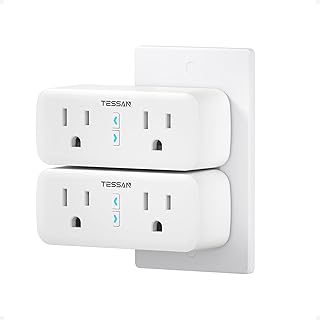
Turn lamps, coffee makers and more into smart devices—voice or app control, dual outlets, schedules and group sharing for effortless convenience.
$24.99 on Amazon
Think of this TESSAN unit as two smart plugs in one body. Each outlet is individually controlled, so you can run a coffee maker on a morning schedule while a lamp goes off at bedtime. Group control keeps routines tidy, and voice control via Alexa/Google is great for hands-free toggles. For renters or anyone who wants minimal clutter, it’s a tidy way to double up automation at a single wall receptacle.
There’s no built-in energy monitoring here, but the scheduling tools are strong. If your goal is to reduce vampire power from lamps, small speakers, or chargers, automations and group scenes make that easy. The spec notes up to 1800W max—smart practice is to avoid loading both outlets near their limit at the same time.
4. Kasa HS103P4 Smart Wi‑Fi Plugs (4‑Pack) — Reliable Basics Across the Home

Add voice control and remote scheduling to lamps, fans and more with the HS103 Kasa smart plug — easy app setup and step-by-step guidance.
$29.99 on Amazon
When you want dependable, no-drama smart plugs to automate lamps, fans, or humidifiers, the HS103 series nails the basics. Kasa’s app is polished and beginner-friendly, with step-by-step onboarding and intuitive scheduling tools. Voice control through Alexa or Google is quick, and having four plugs lets you standardize your setup across rooms.
These don’t track power usage, so you won’t see live wattage or kWh totals. Still, schedules and scenes can meaningfully reduce standby consumption by shutting down devices overnight or while you’re away. If you’re building routines first and tracking second, this four-pack is a reliable backbone for an efficient home.
5. Kasa KP303 Smart Power Strip — Three Smart Outlets + Two USBs with Surge Protection

Independently control 3 outlets + 2 USBs via Kasa app or Alexa/Google—schedule, power devices remotely, great for home offices, family rooms, or holiday lights.
$23.38 on Amazon
A desk or media center often hides multiple vampire devices: docks, subwoofers, consoles, chargers. The KP303 tackles them all with one smart power strip. Control three AC outlets independently from the Kasa app or by voice with Alexa/Google, and charge phones or tablets from the two USB ports. Surge protection adds peace of mind for your gear.
While there’s no energy metering built in, the ability to create schedules per outlet is an energy saver. For example, keep your workstation live during business hours and shut it down each night, or turn on holiday lights at sunset and off at bedtime. If you’re wrangling more than one device, this smart power strip is a cleaner solution than stacking individual plugs.
6. Kasa KP200 In‑Wall Smart Plug — Clean, Permanent Install With Voice Control

Smart, reliable smart-home gear born from TP-Link’s Silicon Valley R&D, with easy setup, dependable automation, and design made for real homes. Discover why.
$17.98 on Amazon
Prefer a built-in look over plug-in adapters? The KP200 replaces your existing outlet, keeping everything tidy while adding full app and voice control for both receptacles. It’s great for permanent installations where a clean, always-ready solution beats a bulky adapter, and Kasa’s app makes schedules and automations straightforward.
There’s no power usage readout or energy history, so if you need kWh data, choose one of the monitoring models above. Plan on standard electrical skills (or a professional) to install; you’ll also need a neutral wire. Once in place, it’s a set-and-forget smart outlet that blends right in.
FAQ
- Do I need energy monitoring to save money?
No—but it helps. Scheduling and routines alone can cut vampire power by turning devices fully off overnight or when you’re away. Energy monitoring makes savings visible and helps you focus on the biggest offenders, so you can fine-tune schedules with confidence.
- How accurate are smart plug energy readings?
For steady loads (lamps, heaters), readings are typically quite accurate and consistent. For variable electronics (computers, TVs), numbers can fluctuate but still reveal meaningful patterns. If you need detailed analysis, choose a plug that offers historical charts or data export.
- What’s the difference between Wi‑Fi and LoRa (YoLink)?
Wi‑Fi plugs connect directly to your home network and your voice assistant. YoLink uses LoRa, a long-range, low-power radio that talks to a hub. LoRa reaches farther and penetrates walls better—great for basements, detached spaces, or large homes. You’ll manage everything via the YoLink hub and app.
- Can these plugs handle space heaters or dehumidifiers?
Check the plug’s rating. Models with 15A support (like YoLink) are better suited to higher-current appliances. Avoid overloading, and don’t run multiple heavy devices from a single dual-outlet smart plug or strip unless explicitly supported.
- Is Matter worth it?
Matter enables cross-ecosystem control—Alexa, Google, Apple Home, SmartThings—with a single device line, making your setup more future-friendly. If you switch platforms or use multiple, Matter (as on the Tapo P110M) simplifies life.
Powering Down the Waste: Final Picks and Smart Pairings
The goal is simple: cut waste without complicating your life. If you want the clearest path to real savings, grab an energy-monitoring model, identify your biggest vampire loads, and automate around them. If you just need reliable control and scheduling, the non-monitoring plugs and strips below pack a lot of value.
- Best for accurate, exportable energy data and hard-to-reach places: YoLink YS6614. Long-range LoRa and 15A support make it a top choice for heavier appliances and challenging homes.
- Best for multi-ecosystem homes (Alexa/Google/Apple/SmartThings) with energy insights: TP‑Link Tapo P110M. Matter compatibility plus usage stats hit a sweet spot for most households.
- Best dual-outlet convenience at one wall receptacle: TESSAN Dual-Socket 2‑Pack. No energy stats, but powerful scheduling across two independently controlled outlets.
- Best starter bundle for whole-home scheduling: Kasa HS103P4. Reliable app, voice control, and a four-pack to tackle multiple rooms at once.
- Best for home offices and AV setups: Kasa KP303 Smart Power Strip. Individually control three outlets, add surge protection, and create time-based energy-saving routines.
- Best for a clean, built-in look: Kasa KP200 In‑Wall Smart Plug. Permanent, tidy control with Alexa/Google—ideal where you don’t want adapters.
One last tip: After you set schedules, check your energy dashboards (on monitoring models) after a week. Look for the quiet hours—those are prime vampire-power windows. Trim, test, and repeat. You’ll see the difference on your next bill, and your automations will run themselves long after you forget they’re there.




Leave a Comment