

The Best Overhead Garage Storage Racks and Ceiling Hoists to Reclaim Your Floor
Ever feel like your garage has a floor only in theory? Boxes tower, bikes lean, and seasonal gear drifts to wherever gravity allows. The ceiling is your underused frontier. With the right overhead garage storage rack or a heavy-duty garage ceiling hoist, you can lift clutter out of your way and bring order back—without sacrificing access.
Below, we break down how to choose between static ceiling-mounted racks and hoist systems, what to know before drilling into drywall versus joists, and how to think about durability. Then we review four strong picks—two overhead solutions plus three smart add-ons that round out a space-efficient, safer garage.
Why Overhead Storage Pays Off (and What It’s Best For)
A garage’s fifth wall—the ceiling—adds square footage without adding a single stud. By shifting seldom-used items overhead, you reclaim walking space and work zones while reducing trip hazards. It’s also easier to keep pests and moisture away from long-term storage when it’s off the slab.
Ideal overhead candidates:
- Seasonal totes (holidays, winter/summer clothes)
- Camping gear and coolers
- Luggage
- Sports bins and spare household items
- Long, awkward items (with a hoist): kayaks, canoes, SUPs, rooftop boxes
Overhead racks shine when you want a stable “shelf in the sky” for bins. Ceiling hoists shine when the problem isn’t weight so much as shape and maneuverability—think kayaks and canoes that are light enough but awkward and risky to lift by hand.
Static Overhead Racks vs. Ceiling Hoists: How to Choose
Ceiling-mounted storage racks are set-and-forget. Once installed, you’ve got a reliable platform rated for hundreds of pounds. They’re perfect for tubs and boxes you only need a few times a year. Downsides? You still have to lift items up there or use a step ladder—and once loaded, you don’t reconfigure them often.
Heavy-duty garage ceiling hoists add motion. A quality hoist brings the load to you—lower to chest height, load it safely, then lift it overhead. This is a huge win for kayaks, canoes, cargo boxes, and even large totes if your shoulders aren’t thrilled about ladder work. The trade-off is more moving parts (pulleys, cables, locks) and a bit more planning for safe installation and ceiling clearance around door tracks and openers.
Quick rule of thumb:
- Choose a static overhead rack for heavy bins and seasonal storage you rarely touch.
- Choose a hoist for bulky, long items or if lifting heavy loads overhead is a non-starter.
Installation and Safety: Drywall vs. Joists, 16″ vs. 24″ on Center
Overhead storage only works when it’s anchored correctly. That means fastening into solid framing members—never hanging a ceiling rack from drywall alone.
What to check first:
- Joist spacing: Most garages are 16 inches on center; some are 24 inches. Many overhead systems provide brackets that accommodate either. Always verify compatibility.
- Framing type: Dimensional lumber vs. engineered I-joists vs. open-web trusses. Follow the manufacturer’s instructions for lag bolt size, number of fasteners, and any blocking requirements.
- Ceiling finish: For finished drywall ceilings, you’ll need a stud/joist finder to locate centers precisely. Mark your layout before drilling, and pre-drill pilot holes for lag bolts.
- Clearance: Measure the distance to garage door tracks, openers, light fixtures, and vehicles. Consider tall vehicles (SUVs, trucks) with roof racks or antennae.
- Load realism: Respect the rated capacity and leave a safety margin. Capacity is only as strong as both the product and the structure it’s attached to.
Durability markers:
- Powder-coated steel resists rust.
- Grade-marked hardware and thick-gauge brackets prevent flex.
- For hoists, look for safety locks, sturdy cable or webbing, and smooth pulleys that don’t chew through lines.
How We Selected the Best
We evaluated ceiling-mounted storage racks, a heavy-duty ceiling hoist, and add-on organizers using the following criteria:
- Real-world capacity and stability (and how easy it is to actually use that capacity)
- Compatibility with common joist spacings (16″/24″ on center) and finished drywall ceilings
- Installation clarity: hardware quality, instructions, adjustability, and error tolerance
- Durability: steel gauge, coating, and robust connection points
- Safety: lock mechanisms for hoists, anti-rack flex, and sensible weight distribution
- Access and ergonomics: is it safe and practical to load/unload?
- Who it’s for: matching the product to a shopper’s project, ceiling, and storage mix
Below are the four products to consider—starting with compact wall and freestanding pieces that make overhead systems easier to use, then the ceiling-mounted stars.
1. StoreYourBoard 4‑Hook Wall-Mounted Steel Rack for Garage & Garden Tools — Best Simple Add-On to Free Overhead Space

Price and availability are accurate as of 12/21/2025 07:00 am GMT and are subject to change.
Sometimes the smartest move isn’t to send everything overhead—it’s to get the tall, tangle-prone items onto a wall so overhead racks can handle what they do best. This compact 4-hook steel rack organizes rakes, shovels, and extension poles, reclaiming floor space and making bin-based, ceiling-mounted storage actually usable.
Installation is straightforward: hit wall studs with the provided hardware, and you’re done. Because you’re mounting to a vertical surface, there’s less anxiety versus drilling into ceiling joists. That makes it a perfect first step if you’re building toward a full ceiling-mounted storage setup.
Who should buy this: Homeowners who plan to use an overhead rack for bins and want long-handled tools off the floor and out of the way. Also great for anyone who wants a simple add-on that doesn’t require working overhead.
2. C2M Floating Wall Tool Shelf — Heavy-Duty Steel Organizer, 100 lb Capacity (Red) — Best Wall Station for Power Tools Under Your Overhead Zone

Price and availability are accurate as of 12/21/2025 07:01 am GMT and are subject to change.
Overhead racks keep seasonal bins out of the way; tool shelves keep your daily drivers close. This heavy-duty steel station holds drills and batteries, keeping chargers ventilated and cords tidy. Mounted to studs, it’s solid enough for routine use and prevents your overhead area from becoming a catchall for small items that don’t belong up there.
For installation, treat it like any serious garage fixture: find studs, use appropriate lag screws, and mount at a height that leaves elbow room above work surfaces. Once your tools live here, your ceiling rack can do what it’s meant to do—store the big stuff.
Who should buy this: DIYers and contractors who want a secure tool station below an overhead rack, ensuring frequently used gear stays accessible without climbing a ladder.
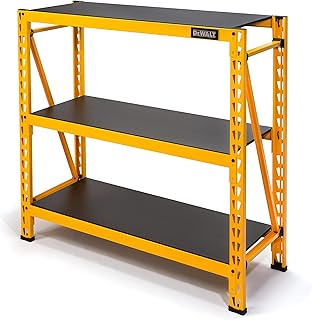
3. DEWALT 4-Foot 3-Shelf Workshop Rack — 4,500 lb Heavy-Duty Capacity — Best Floor Rack When Ceiling Mounting Isn’t an Option
Price and availability are accurate as of 12/21/2025 07:01 am GMT and are subject to change.
Ceiling mounts aren’t always feasible. Maybe your ceiling is full of obstacles, or you’re in a rental where drilling overhead is a no-go. This 4-foot, 3-shelf steel rack gives you industrial-grade strength on the floor—no joists required. It’s overbuilt for heavy bins, compressors, and shop equipment.
While it won’t lift anything off the floor, it’s the right answer when structural unknowns or lease restrictions rule out ceiling storage. It also pairs well with a hoist: store the kayak’s accessories on the rack, and keep the boat itself overhead.
Who should buy this: Anyone who needs serious storage without touching the ceiling—renters, shops with engineered trusses you can’t penetrate, or owners who want a mixed storage setup that balances floor and overhead solutions.
4. FLEXIMOUNTS Classic 3×6 Adjustable Overhead Garage Rack — 450 lb Capacity — Best Static Ceiling Rack for Seasonal Bins

Price and availability are accurate as of 12/21/2025 07:01 am GMT and are subject to change.
When your primary goal is to move a lot of stuff up and out of the way, a classic ceiling-mounted storage rack is hard to beat. This 3×6 platform gives you a generous overhead footprint and a 450 lb rating for totes and seasonal gear. Adjustable height makes it easier to fit around the realities of a garage—door tracks, openers, and light fixtures.
As with any ceiling rack, the priority is safe structure: find joists precisely, pre-drill, and use manufacturer-specified hardware. Work with a helper during installation. If your load mix is mostly bins rather than awkward objects, this static rack is the more cost-efficient, low-maintenance solution compared with a hoist.
Who should buy this: Homeowners who want maximum cubic storage for seasonal totes and infrequently used items, and who are comfortable installing into ceiling joists or hiring a pro.
FAQ
- Do I need to mount into joists, or can I use drywall anchors?
- For ceiling racks and hoists, always mount into structural framing—joists or properly installed blocking. Drywall anchors are not sufficient for overhead loads.
- How do I know if my ceiling is 16″ or 24″ on center?
- Use a stud/joist finder and measure the distance between joist centers. Many garages are 16″ on center, but 24″ is also common. Choose products designed to accommodate your spacing.
- What’s better for a kayak: a static rack or a hoist?
- A hoist wins on safety and convenience. It allows you to load at chest height, then lift the kayak overhead with a mechanical advantage and a safety lock. Static racks are better for stacked totes and boxes.
- How much clearance do I need for an overhead rack?
- Measure from the ceiling down to any obstruction (garage door when open, opener, lights), then subtract the rack’s minimum height and the height of your totes. You also need adequate vehicle clearance; account for roof racks and antennas.
- Can I install a ceiling rack by myself?
- It’s possible but not recommended. Working overhead with heavy steel components is awkward and potentially unsafe solo. A helper improves accuracy and safety, and a pro installer is worth considering if you’re unsure about joist layout or hardware.
Headroom, Hoists, and a Happier Garage: Final Recommendations
If you’re new to ceiling storage, start by freeing your walls. Use the StoreYourBoard 4‑Hook Rack to get long-handled tools off the floor, and the C2M Floating Wall Tool Shelf to corral power tools and chargers. This clears the decks so your overhead system can handle the big lift.
For heavy bins and seasonal gear you don’t need weekly, the FLEXIMOUNTS Classic 3×6 Overhead Rack offers the best balance of capacity, adjustability, and simplicity. It maximizes cubic storage with minimal ongoing fuss.
If you’re storing long, awkward items—kayaks, canoes, rooftop cargo boxes—or simply don’t want to lift heavy loads up a ladder, choose the GADFISH Garage Ceiling Lift. Its 350 lb rating, safety lock, and 16″/24″ joist compatibility make overhead storage far safer and more accessible.
And if your ceiling is off-limits or complex, the DEWALT 4-Foot 3-Shelf Workshop Rack delivers massive, reliable capacity on the floor. Pair it with a hoist to keep bulky items up high while storing accessories and heavy gear below.
The win here isn’t just more space—it’s better space. Pick the overhead or hoist solution that matches your gear, mount it safely to solid framing, and use wall and floor pieces to keep the essentials within easy reach. Your future self (and your car doors) will thank you.








Leave a Comment