

Best Reloading Scales and Essentials: Accurate Grain Weighing for Safer, More Consistent Ammo
If your powder charge isn’t right, nothing else about your handload can be. A trustworthy reloading scale is the difference between a “maybe” and a “known-good” round. This roundup zeroes in on digital scales that read in grains, plus the must-have references and accessories that help you get repeatable, safe results at the bench.
Why this category matters
Powder charges are measured in grains, and a tenth of a grain can be significant—especially in high-pressure pistol loads or when you’re chasing single-digit SDs in a precision rifle. That’s why kitchen scales won’t cut it. You need a scale that resolves small changes, stays stable while you trickle, and can be calibrated to known weights on demand.
Equally important is consistency. A scale with good repeatability will show the same weight for the same charge every time. The right accessories—draft covers, a rigid stand for your powder measure, and current data in a quality manual—turn good equipment into a system you can trust.
Common use cases for reloaders
Most reloaders use their scale for three jobs. First, setting and periodically verifying a powder measure. Throw five to ten charges into the pan, weigh, and average; you’ll catch drift or bridging before it bites you. Second, trickling to final charge weight for match ammo. This is where stable readings and predictable response to each kernel you add really matter. Third, weight-sorting bullets and brass to tighten ES/SD and reduce vertical at distance.
Pocket scales come into their own at the range or on a compact bench. They’re great for quick checks, verifying thrown charges, and sorting components. Bench scales with larger platforms and dedicated pans are better for daily loading sessions, trickling, and minimizing operator-induced errors.
How to shop for a reloading scale
Understand resolution vs. accuracy vs. repeatability. Resolution is the smallest increment displayed (e.g., 0.1 grain). Accuracy is how close the reading is to true weight. Repeatability is whether it shows the same number for the same object consistently. You want all three to be solid for powder work.
Capacity matters, but not as much as stability in the weight ranges you actually use. For most, a 1500-grain capacity is plenty for powder, bullets, and even loaded rounds. Draft control is huge. A wind/dust cover or clamshell lid keeps air currents and HVAC from making your readings dance. A rigid, level bench, AC power (or stable USB power), and a warm-up period improve stability and reduce drift.
Selection criteria: what makes a product “best” here
- Grain-first thinking: True grain units, sensible resolution for powder (ideally 0.1 grain) and consistent readings while trickling.
- Calibration ready: Included weights make it easy to confirm accuracy before you start. Quick, simple calibration routines are a plus.
- Stability: Draft shields, covers, and a solid platform reduce drift from air currents and bench vibration.
- Practical capacity and platform: Enough range for powder, bullets, and brass with a usable pan or platform.
- Real-world usability: Backlit displays, clear controls, tare function, and power options that fit your bench.
- Trustworthy data and workflow: Authoritative reloading manuals and a stable powder measure setup complement your scale and improve outcomes.
Below you’ll find a tight list: one bench-grade digital reloading scale, two portable 0.01 g pocket scales that can display grains for quick checks, a rock-solid stand for your powder measure, and two comprehensive reloading manuals to keep your charge weights inside safe, published limits.
1. Frankford Arsenal Platinum Series Precision Scale — 1500-gr capacity, 1/10-grain accuracy

Hornady 11th Edition reloading manual — 1,000+ pages, 200+ calibers, updated powders & bullets. Clear charts and tips for beginners and seasoned handloaders.
$0.00 on Amazon
View on AmazonPrice and availability are accurate as of 01/27/2026 11:00 pm GMT and are subject to change.
If you want a dedicated bench scale for powder, the Frankford Arsenal Platinum Series is the practical sweet spot. It’s purpose-built for handloading tasks, with 1/10-grain accuracy and a 1500-grain capacity that covers powder, bullets, cases, and even loaded rounds. The large backlit screen is easy to read at arm’s length, and the controls keep unit switching and taring simple.
You get the right accessories in the box: calibration weights to quickly verify accuracy before a session, a powder pan that actually fits the platform, a clear cover that doubles as a draft break, and both 110V and 220V power options. Set it on a level bench, let it warm up, calibrate, and you’re ready to trickle to final weight without squinting or guessing.
Serious competitors may want a scale with sub-0.1-grain resolution and a full draft shield, but for most reloaders, this is a balanced, reliable workhorse for day-to-day precision loading.
2. MAXUS 200g x 0.01g Precision Pocket Scale — USB-powered, grain mode, calibration weight included

Mounts to bench or wall and raises your powder measure for easy case positioning. Tough die-cast aluminum in bright yellow – a simple upgrade for cleaner, faster reloading.
$35.86 on Amazon
View on AmazonPrice and availability are accurate as of 01/27/2026 11:00 pm GMT and are subject to change.
This MAXUS pocket scale is a smart pick for portable verification. It supports grains alongside grams, ounces, carats, and more, and it ships with a 50 g calibration weight—handy for confirming accuracy before you rely on a reading. The backlit display is easy to see in dim garages, and the stainless platform wipes clean between powders.
Think of it as a check scale and sorter. It’s ideal for verifying a powder measure throw, spot-checking component weights, or sorting bullets and cases into tighter lots. USB power helps reduce low-battery drift, and the rubberized body survives bench bumps.
For fine trickling, note the math: 0.01 g increments are roughly 0.154 grain. In grain mode, you can hit typical target weights, but kernel-by-kernel precision won’t be as satisfying as a bench scale with native 0.1-grain resolution. Shield it from drafts or use the lid as a wind break to keep readings steady.
3. Precision Pocket Scale 200g/0.01g — Shockproof clamshell with calibration weight and 6 units

Compact, high-precision pocket scale: stainless platform, backlit LCD, dual power, multiple units and included calibration weight—perfect for jewelry, coins, food, travel.
$14.99 on Amazon
View on AmazonPrice and availability are accurate as of 01/27/2026 11:01 pm GMT and are subject to change.
This UNIWEIGH mini scale is built for life on and around the bench. The rubberized clamshell case shrugs off knocks, protects the stainless platform, and can be positioned to block air currents during use. With six unit modes including grains, it’s a versatile tool for checking throws, sorting bullets by weight, and verifying case weights before or after prep.
It’s plug-and-play friendly: the 50 g calibration weight and included batteries mean you can calibrate and start using it right away. The tare function simplifies container weighing, and overload/low-battery indicators prevent head-scratching readings.
Like other 0.01 g pocket scales, it excels as a check scale, not as your primary trickling station. The 180-second auto-off is great for saving battery but can be annoying if you’re slow-trickling a charge; tap a button periodically to keep it awake, or use it for verification while a bench scale handles the fine work.
4. Lyman Brass Smith Powder Measure Stand — Stable, standard-threaded, bench or wall mount

1/10-grain precision to 1500gr, big backlit display, included weights & case—easy, accurate results for your reloading bench. Worth checking out.
$75.95 on Amazon
View on AmazonPrice and availability are accurate as of 01/27/2026 11:01 pm GMT and are subject to change.
Consistent charges start with a consistent throw, and that starts with a stable, ergonomic powder measure position. Lyman’s Brass Smith stand lifts your measure high enough to slide cases comfortably under the drop tube, and the standard 7/8″-14 threads keep compatibility straightforward. Mounted to a bench or wall, it frees up workspace and helps isolate measure operation from your scale area.
Why include it in a weighing roundup? Because a clean, repeatable throw reduces how much trickling you need and makes your scale readings more predictable. A good stand minimizes bumps and spills that can introduce variances or contaminate your scale platform.
Pair this with a reliable digital scale: throw slightly low, weigh, and trickle to final. You’ll move faster with fewer surprises, and your scale won’t be fighting vibrations every time you pull the measure handle.
5. Hornady Reloading Manual, 11th Edition — 1,000+ pages of updated load data and ballistics
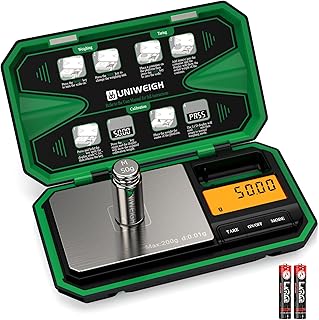
Handy pocket 200g/0.01g digital scale — shockproof clamshell, 6 units, tare + calibration weight included. Great for jewelry, herbs, spices or travel.
$17.99 on Amazon
View on AmazonPrice and availability are accurate as of 01/27/2026 11:02 pm GMT and are subject to change.
A scale is only as useful as the data you feed it. The Hornady 11th Edition is a comprehensive, current guide to safe, effective powder charges across a huge array of cartridges, including new additions like 6mm ARC, 6.5 PRC, 300 PRC, 224 Valkyrie, 350 Legend, and 28 Nosler. Charts are clean, and the narrative sections demystify internal, external, and terminal ballistics for practical decision-making.
For powder weighing, this manual tells you your start and max charges in grains and often provides insights about pressure curves and seating depth interactions that affect safe charge ranges. It’s a one-stop reference to build a loading plan you can trust, then verify on your scale.
Every reloader benefits from multiple sources. Use this as a primary reference and sanity-check against other manuals and powder maker data. Then weigh carefully and work up slowly.
6. Lyman 51st Edition Reloading Handbook — Broad, neutral softcover reference

Price and availability are accurate as of 01/27/2026 11:02 pm GMT and are subject to change.
Lyman’s 51st is a staple for a reason. It brings a broad, brand-agnostic view to load data and method, making it an excellent companion to bullet-specific manuals. For your scale work, it serves two vital roles: confirming safe start/max charge windows and offering process guidance that improves consistency (case prep, seating depth, crimp, and more).
When grain numbers disagree between sources—as they sometimes do—Lyman’s neutral data helps triangulate a safe starting point. Keep it within arm’s reach when you’re setting your powder measure, calibrating your scale, and logging charge weights. Cross-referencing plus careful weighing equals safer, more repeatable ammunition.
FAQ
How precise should a reloading scale be?
For most handloading, a digital scale with 0.1-grain resolution and solid repeatability is the standard. That gives you confidence when trickling to a target weight. Pocket scales with 0.01 g resolution can display grains, but 0.01 g equals about 0.154 grain. They are fine for verification and sorting but less ideal for fine kernel-by-kernel trickling.
Do I really need a draft shield or wind cover?
Yes, some kind of draft control helps a lot. Even subtle air currents from HVAC or a sleeve brushing past can cause readings to fluctuate. A dedicated scale cover or clamshell lid used as a wind break will stabilize readings, reduce drift, and make trickling more predictable.
How do I calibrate my scale correctly?
Place the scale on a level, stable surface away from drafts and vibration. Power it on and let it warm up per the manual. Run the calibration routine using the supplied weight(s), ideally with the same power source you’ll use while weighing (AC, USB, or fresh batteries). Tare with your powder pan on the platform. Recheck with the calibration weight mid-session if you notice drift.
Can a jewelry/coin pocket scale work for reloading?
Yes—with caveats. Pocket scales are great for quick checks, verifying thrown charges, and sorting bullets or brass, especially when they have a grain unit option. For primary powder charge setting and trickling, a bench scale designed for grain-level work is more stable and predictable due to better draft control, response, and platform ergonomics.
What’s the best way to keep readings stable while trickling?
Use AC or steady USB power, warm the scale up, and isolate it from vibration. Block drafts with a cover, keep the trickler at a consistent distance, and add powder slowly at a constant rate. Re-tare if you move containers. Periodically confirm with your calibration weight to ensure nothing has drifted.
Final Shots: Matching the Right Tool to Your Bench
- Best bench scale for powder work: Frankford Arsenal Platinum Series Precision Scale. True 0.1-grain accuracy, included calibration weights, and a cover that calms drafts make it a confident daily driver.
- Best budget pocket checker: MAXUS 200g x 0.01g. USB power, a 50 g calibration weight, and grain mode make it perfect for verifying throws and sorting components.
- Most rugged pocket option: UNIWEIGH 200g/0.01g. The shockproof clamshell protects the platform and doubles as a wind break for steadier readings.
- Best stability upgrade for your powder measure: Lyman Brass Smith Stand. A quieter, cleaner powder drop means less trickling and faster, more consistent weighing.
- Must-have data backbone: Hornady 11th Edition Reloading Manual. Up-to-date grains-based charge windows and clear ballistics make scale work safer and smarter.
- Best cross-check: Lyman 51st Edition Handbook. A brand-neutral reference to validate charge ranges and process choices.
Build your setup around stable, verifiable measurements. Calibrate before each session, control drafts, and work within published grain ranges. Do that consistently, and your handloads will show it on paper and over the chrono.








Leave a Comment